


Sharing a backyard pool sounds easy until two adults want different things from it.
One person may want calm, steady swimming. The other may prefer light movement and stretching. One may enjoy tracking progress. The other may hate numbers. One may want early morning sessions. The other may feel better after work. One may be confident in the water. The other may still be building comfort.
If those differences are not named, pool fitness can become awkward.
One person feels pushed. The other feels slowed down. A shared routine turns into comparison. The pool starts to feel like another place where someone is ahead and someone is behind.
It does not have to be that way.
Two adults can share one pool well if they respect different goals, create separate rhythms, and avoid turning every session into a test.
The pool should support both people, not rank them.
Start With Separate Goals
The first step is admitting that the goals may be different.
One person might want conditioning. Another might want mobility. One may want to rebuild swimming confidence. Another may want a low-impact break from running. One may want quiet time more than exercise.
Write the goals separately.
Do not force them into one shared fitness plan too quickly.
A shared pool does not require identical routines. In fact, it usually works better when each person has a clear personal reason for using it.
Separate goals reduce resentment.
They also make support easier because each person knows what the other is trying to protect.
Avoid the “Same Workout” Trap
Couples, roommates, or adult family members often assume they should do the same workout if they are using the same space. That can create pressure.
The stronger swimmer may get bored. The less experienced swimmer may feel embarrassed. The person who wants calm movement may feel dragged into intensity. The person who likes structure may feel the session is too casual.
Instead, share the space, not necessarily the workout.
One person can do steady swimming while the other does water walking. One can use intervals while the other practices breathing. One can train first while the other stretches on the patio.
Together does not have to mean identical.
Create Pool Time Blocks
If both adults want focused pool time, schedule blocks.
For example:
6:30 to 7:00 belongs to one person.
7:00 to 7:30 belongs to the other.
Saturday morning is shared movement.
Sunday evening is quiet recovery.
This prevents conflict.
Nobody has to negotiate every time. Nobody has to feel like they are interrupting. The pool has a rhythm.
Blocks can be short. Even 20 minutes can matter if the time is protected.
A shared home works better when personal routines have visible space.
Build a Shared Resource Folder
If both adults are using the pool for movement, create one shared resource folder. Keep it simple.
It can include schedules, session ideas, safety reminders, personal goals, and links that support planning. A couple may save iGarden Swim Jet in that folder beside notes about swim timing, resistance training ideas, recovery sessions, and how to keep the pool useful for two different fitness styles.
The purpose is not to overplan.
The purpose is to keep useful information in one place so the routine does not depend on scattered texts, browser tabs, or memory.
Use Different Success Measures
Two adults may need different definitions of progress.
For one person, success might be swimming longer without stopping. For another, it might be feeling less nervous in the water. For another, it might be keeping a twice-a-week habit. For another, it might be using the pool to reduce joint stress.
Do not measure everyone with the same ruler.
Ask each person to name their own success measure.
This protects motivation.
It also prevents casual comments from becoming discouraging. “You only swam ten minutes?” may sound harmless, but it can feel dismissive if ten minutes was a real win.
Personal progress deserves personal context.
Keep Coaching by Consent Only
This rule matters.
If one person is a better swimmer, they may want to offer tips. That can be helpful, but only if the other person wants coaching.
Unwanted correction can make the pool feel unsafe emotionally.
Use a simple agreement: ask before giving feedback.
“Do you want a suggestion, or are you just practicing?”
“Would it help if I watched your breathing, or do you want to stay in your own rhythm?”
This kind of respect keeps the routine healthy.
Support should not feel like surveillance.
Protect Quiet Sessions
Sometimes one person may want to use the pool alone. That should be allowed.
A solo session can be important even in a strong relationship. It gives someone space to move without conversation, comparison, or performance.
Respect that.
If the pool is in solo mode, the other person can wait, stretch, read, or use the space later.
Togetherness is valuable, but so is privacy.
A shared pool works better when both adults can have quiet ownership at different times.
Create One Shared Session per Week
Separate routines are helpful, but one shared session can keep the pool connected to the relationship.
Make it low-pressure.
This might be a Sunday evening float, a gentle water-walking session, a short interval where each person works at their own level, or a relaxed mobility routine.
The purpose is not competition.
The purpose is shared presence.
One session per week can make the pool feel like a common space without forcing every workout to be shared.
Keep Equipment and Towels Separate
Small practical details can prevent irritation.
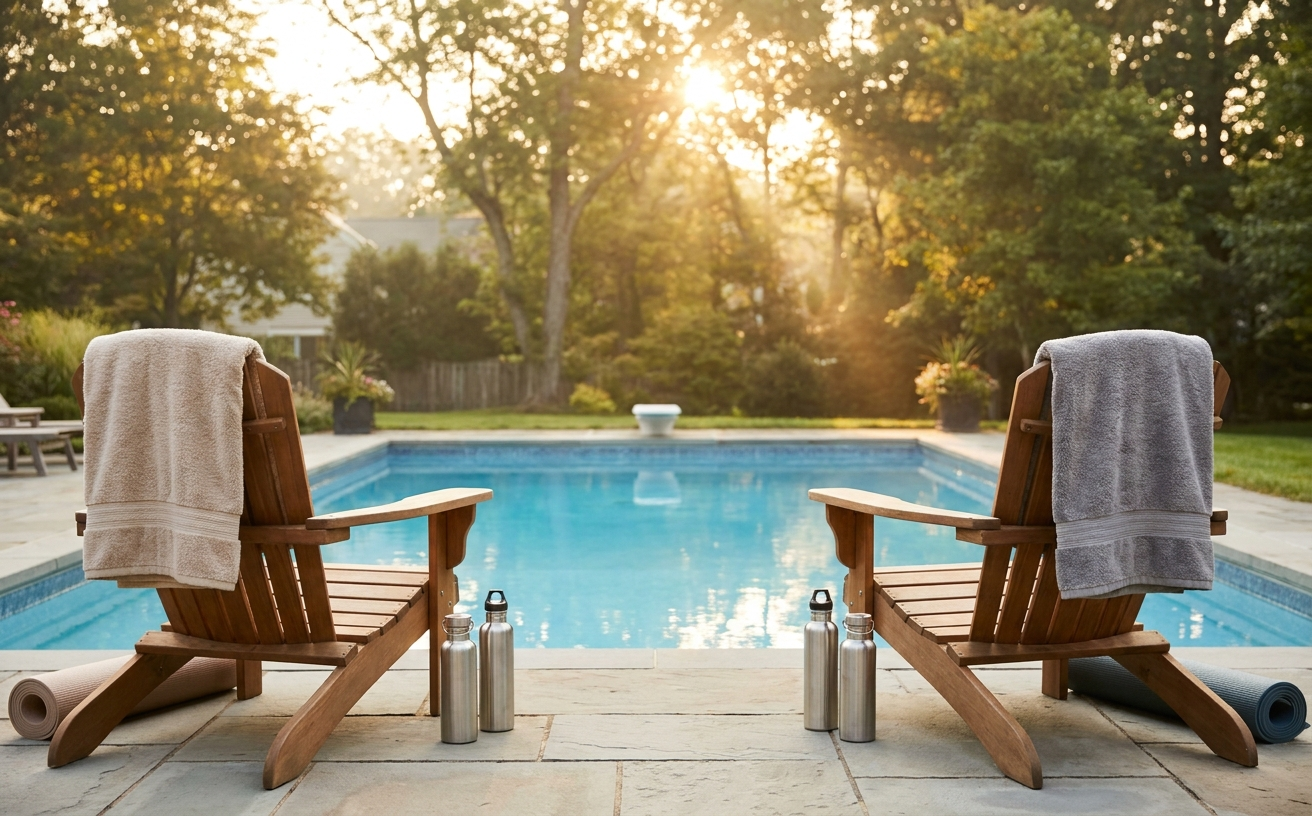
Use separate towels. Separate goggles if needed. Separate water bottles. Separate storage spots for personal items.
This avoids the “where is my towel?” problem.
It also lets each person prepare for their own routine without disrupting the other.
Shared space works better when personal items have clear homes.
That is true in kitchens, bathrooms, offices, and pool areas.
Talk About Energy, Not Just Time
A person may technically have time to swim but not have the energy. Work stress, sleep, errands, parenting, and health can all affect the body.
Before assuming someone is skipping the routine, ask about energy.
“Do you want a lighter pool session today?”
“Would stretching feel better than swimming?”
“Do you want the pool to yourself?”
This keeps the routine flexible.
A fitness habit should support real life, not punish people for having human limits.
Do Not Make the Pool a Scoreboard
Numbers can be useful, but they can also create tension.
If one person tracks time, distance, or effort and the other does not, that is fine. The numbers should not become household rankings.
Avoid comparing sessions unless both people enjoy that kind of motivation.
The pool should not become a scoreboard.
For many adults, the value is in consistency, recovery, confidence, and calm. Those things are harder to measure but still meaningful.
Review the Routine Together
Once a month, have a short check-in.
Ask:
- Is the schedule working?
- Does anyone feel crowded?
- Does anyone need more solo time?
- Are shared sessions enjoyable?
- Are the goals still current?
- What would make the routine easier?
Keep the conversation practical.
This prevents small frustrations from becoming silent resentment.
A shared pool routine needs maintenance just like any other shared household system.
Let the Pool Support the Relationship
A backyard pool can become more than a fitness space. It can become a place where two adults learn how to respect different bodies, different goals, and different rhythms.
That is valuable.
One person does not need to become the other person’s coach. One does not need to match the other’s pace. One does not need to prove anything.
The best shared pool routines leave both people feeling supported.
Sometimes that means training separately. Sometimes it means floating together. Sometimes it means cheering quietly. Sometimes it means saying nothing and letting the water do the work.
A pool can hold all of that if the people sharing it are willing to make space for each other.
That is how one backyard becomes useful for two different lives.