


Trigonometry plays a vital role in mathematics, physics, engineering, navigation, and many real-world applications. One of the most important principles in trigonometry is the Law of Sines, a rule that helps us understand the relationship between the sides and angles of a triangle. Whether you are a student, a teacher, or someone revisiting mathematics after a long break, this law provides a powerful and elegant way to solve triangles that are not right-angled.
This article explores the Law of Sines in depth—its meaning, formula, derivation, applications, limitations, and practical examples. By the end, you will have a strong conceptual understanding and the confidence to apply it correctly in different scenarios.
Understanding Triangles in Trigonometry
Before diving into the Law of Sines, it is important to review some basic ideas about triangles.
A triangle is a polygon with three sides and three angles. In trigonometry, triangles are usually classified into two major types:
- Right-angled triangles – One angle is exactly 90 degrees
- Oblique triangles – No angle is 90 degrees
The Law of Sines is specifically designed to work with oblique triangles, which include:
- Acute triangles (all angles less than 90°)
- Obtuse triangles (one angle greater than 90°)
In right-angled triangles, trigonometric ratios like sine, cosine, and tangent are enough. However, when a triangle has no right angle, we need more advanced rules—this is where the Law of Sines becomes essential.
What Is the Law of Sines?
The Law of Sines is a mathematical relationship that connects the lengths of the sides of a triangle to the sines of its opposite angles.
In simple terms, it states that:
The ratio of the length of a side of a triangle to the sine of its opposite angle is the same for all three sides.
This law works for any triangle, regardless of its shape, as long as it is a valid triangle.
Law of Sines Formula Explained
Consider a triangle with:
- Sides: a, b, and c
- Opposite angles: A, B, and C
The Law of Sines formula is:sinAa=sinBb=sinCc
Each fraction represents the same constant value. This means if you know one side and its opposite angle, you can find the other sides or angles using this relationship.
Why the Law of Sines Works
The beauty of the Law of Sines lies in its geometric foundation. It is not just a memorized formula—it comes from the geometry of triangles and the properties of circles.
Every triangle can be inscribed inside a circle (called the circumcircle). When this is done, the sides of the triangle relate directly to the angles formed at the center of the circle. From this geometric relationship, the Law of Sines naturally emerges.
This connection makes the law reliable and universally applicable to all types of triangles.
When to Use the Law of Sines
The Law of Sines is especially useful in the following cases:
1. ASA (Angle–Side–Angle)
When two angles and the side between them are known.
2. AAS (Angle–Angle–Side)
When two angles and one non-included side are known.
3. SSA (Side–Side–Angle)
When two sides and an angle opposite one of them are known (this case may lead to more than one solution).
In contrast, if you are given SAS (Side–Angle–Side) or SSS (Side–Side–Side), the Law of Cosines is usually more appropriate.
Step-by-Step: How to Use the Law of Sines
Applying the Law of Sines follows a clear and logical process.
Step 1: Label the Triangle Correctly
Make sure each side is opposite its corresponding angle.
Step 2: Write the Formula
Use the standard form:sinAa=sinBb
Step 3: Plug in Known Values
Insert the known side lengths and angles.
Step 4: Solve the Equation
Use algebra to find the unknown side or angle.
Step 5: Check Your Answer
Ensure the angles add up to 180° and the sides make sense.
Example 1: Finding a Missing Side
Suppose a triangle has:
- Angle A = 30°
- Angle B = 50°
- Side a = 10 units
To find side b, apply the Law of Sines:sin30°10=sin50°b
Solving this equation gives the value of side b. This type of problem is common in geometry exams and practical measurements.
Example 2: Finding a Missing Angle
If you know:
- Side a = 12
- Side b = 18
- Angle A = 40°
Then:sin40°12=sinB18
Solving for angle B gives you one or possibly two valid solutions, depending on the triangle.
The Ambiguous Case (SSA)
One of the most interesting aspects of the Law of Sines is the ambiguous case, which occurs when:
- Two sides and a non-included angle are given.
In this situation, there may be:
- One triangle
- Two different triangles
- No triangle at all
This happens because the sine function has the same value for two different angles between 0° and 180°.
Understanding the Ambiguous Case Clearly
Imagine swinging a side of fixed length from a known angle. Depending on the length of the other side, it might:
- Reach the base at one point
- Reach it at two points
- Not reach it at all
This geometric interpretation explains why multiple solutions are possible.
How to Handle the Ambiguous Case
To deal with SSA problems:
- Find the sine of the unknown angle.
- Calculate the angle using inverse sine.
- Consider the second possible angle:
180°−angle - Check which solutions form valid triangles.
This step is critical in exams and real-world calculations.
Law of Sines vs Law of Cosines
Both laws are essential, but they serve different purposes.
| Feature | Law of Sines | Law of Cosines |
|---|---|---|
| Best for | ASA, AAS, SSA | SAS, SSS |
| Complexity | Simpler | Slightly more complex |
| Ambiguous case | Yes | No |
Understanding when to use each rule saves time and prevents mistakes.
Real-Life Applications of the Law of Sines
The Law of Sines is not limited to textbooks. It has many practical applications:
1. Navigation and Surveying
Surveyors use it to calculate distances that cannot be measured directly, such as across rivers or valleys.
2. Astronomy
Astronomers use it to determine distances between celestial objects using angular measurements.
3. Engineering
Engineers rely on it for force analysis and structural design involving triangular components.
4. Physics
It helps analyze vector forces and wave behavior.
5. Architecture
Architects use it to calculate angles and lengths in non-rectangular designs.
Common Mistakes to Avoid
Even though the Law of Sines is straightforward, learners often make mistakes:
- Mixing up sides and opposite angles
- Forgetting to consider the ambiguous case
- Using degrees instead of radians incorrectly
- Rounding too early in calculations
Careful labeling and step-by-step work help prevent these errors.
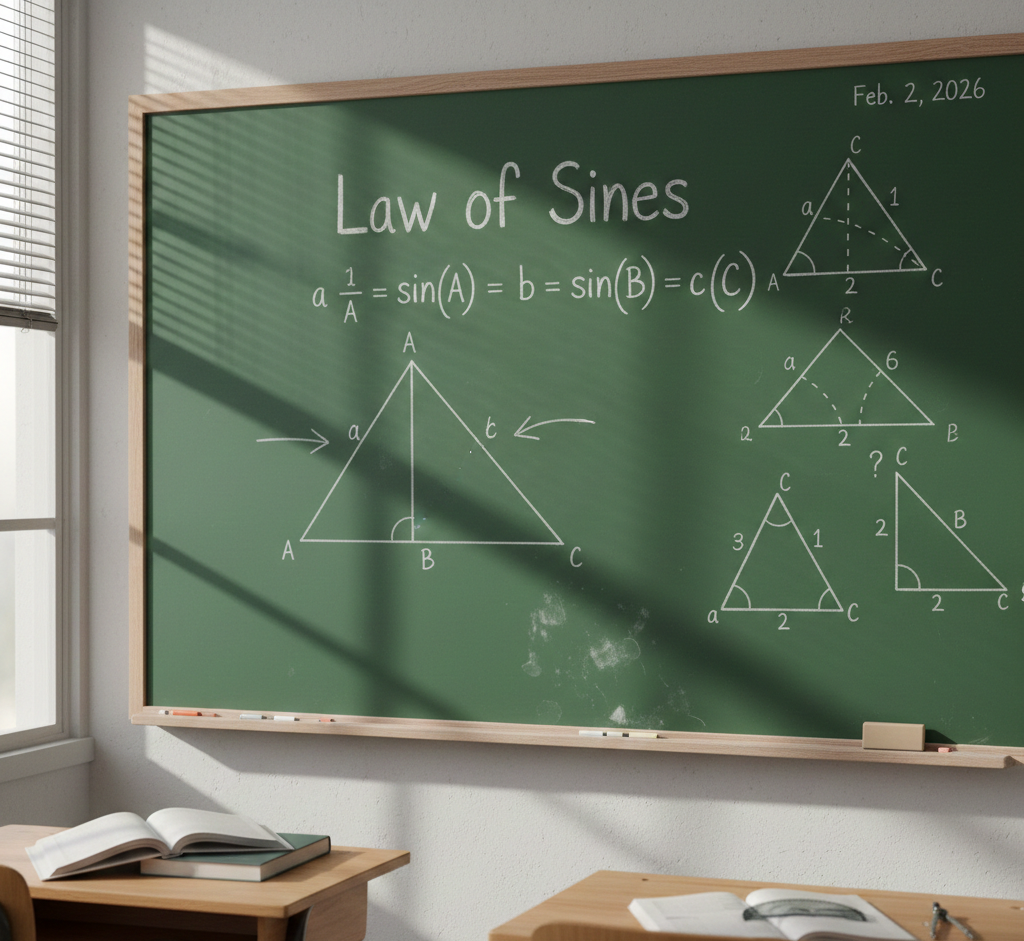
Visualizing the Law of Sines
Drawing a diagram is one of the best ways to understand and apply this law. A clear sketch helps:
- Identify opposite sides and angles
- Avoid incorrect substitutions
- Understand the geometry behind the formula
Visualization is especially useful in complex word problems.
Why the Law of Sines Is Important for Students
Learning the Law of Sines builds:
- Strong problem-solving skills
- Confidence in trigonometry
- A foundation for advanced mathematics
It also connects geometry with algebra, making math feel more logical and less memorization-based.
Tips for Mastering the Law of Sines
- Practice different triangle types
- Always draw a diagram
- Double-check angle sums
- Learn when not to use it
- Compare results with logical estimates
With regular practice, the law becomes second nature.
Frequently Asked Questions
Is the Law of Sines only for triangles?
Yes, it applies exclusively to triangles.
Can it be used for right triangles?
It can, but simpler trigonometric ratios are usually better.
Is the ambiguous case always present?
No, it only occurs in SSA situations.
Final Thoughts
The Law of Sines is one of the most elegant and powerful tools in trigonometry. It bridges geometry and algebra, making it possible to solve triangles that would otherwise seem impossible. From academic problem-solving to real-world applications in science and engineering, this law proves its value time and time again.