


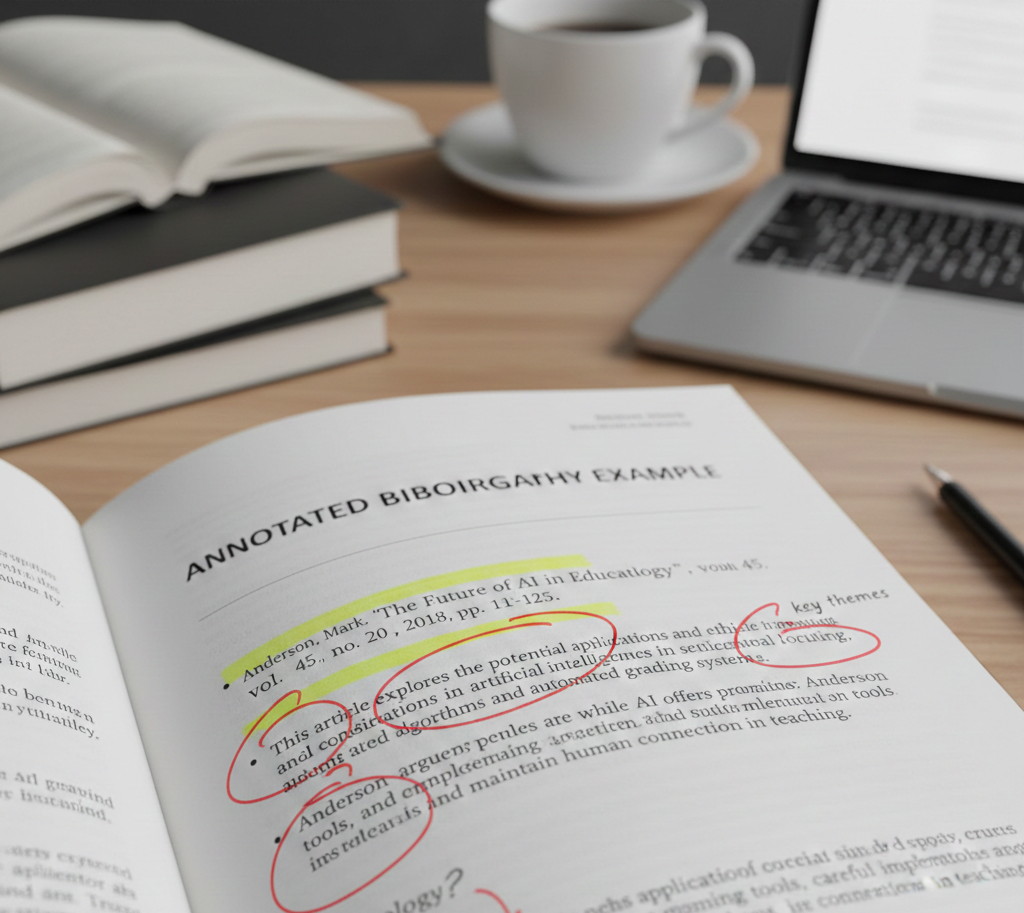
An annotated bibliography example helps students and researchers understand how to properly cite sources while also providing meaningful summaries and evaluations. Whether you are working on a school assignment, college research paper, thesis, or dissertation, learning how to create a structured and well-organized annotated bibliography can significantly improve the credibility of your academic work.
In this comprehensive guide, you will learn what an annotated bibliography is, why it matters, how to format it correctly, and how to write effective annotations. You will also find detailed annotated bibliography examples in different citation styles, practical writing tips, common mistakes to avoid, and advanced strategies for academic success.
What Is an Annotated Bibliography?
An annotated bibliography is a list of citations followed by short descriptive and evaluative paragraphs known as annotations. Each entry includes two main parts:
- The citation (formatted according to a specific style guide)
- The annotation (a paragraph summarizing and evaluating the source)
Unlike a simple reference list, this format provides insight into the relevance, credibility, and usefulness of each source.
Purpose of an Annotated Bibliography
Understanding the purpose behind an annotated bibliography example helps students write better entries. It is commonly used to:
- Demonstrate research depth
- Evaluate source credibility
- Summarize key arguments
- Identify research gaps
- Help readers understand how each source contributes to a topic
- Prepare for literature reviews
Professors often assign annotated bibliographies to assess students’ research and analytical skills.
Key Components of an Annotated Bibliography
Each entry typically includes:
1. Citation
The citation follows a specific style guide such as:
- MLA Handbook
- Publication Manual of the American Psychological Association
- The Chicago Manual of Style
2. Annotation Paragraph
The annotation usually contains:
- Summary of the source
- Evaluation of credibility
- Discussion of strengths and weaknesses
- Relevance to your research topic
Annotations are typically between 150–250 words unless otherwise specified.
Types of Annotations
Different assignments require different types of annotations.
Descriptive Annotation
- Summarizes main points
- Does not include critical evaluation
Evaluative Annotation
- Includes summary
- Critically analyzes credibility and usefulness
Combination Annotation
- Most common type
- Includes summary and evaluation
Step-by-Step Guide to Writing an Annotated Bibliography
Step 1: Choose a Research Topic
Select a focused and researchable topic. Narrow topics produce stronger annotations.
Example topics:
- Social media impact on youth
- Climate change policy
- Artificial intelligence in education
Step 2: Find Credible Sources
Use academic databases, scholarly journals, books, and reputable websites.
Look for:
- Author credentials
- Publication date
- Publisher reputation
- Peer-reviewed status
Step 3: Cite the Source Properly
Follow your required citation style carefully.
Example (MLA style):
Smith, John. Digital Learning in Modern Classrooms. Academic Press, 2022.
Step 4: Write the Annotation
A strong annotation answers these questions:
- What is the main argument?
- What evidence is used?
- Is the source reliable?
- How does it support your research?
Annotated Bibliography Example (MLA Style)
Smith, John. Digital Learning in Modern Classrooms. Academic Press, 2022.
This book explores the transformation of traditional education through digital platforms. Smith argues that technology enhances student engagement and improves access to quality education. The author supports his claims with case studies from universities across the United States and Europe. As a professor of educational technology with over fifteen years of research experience, Smith provides credible insights supported by peer-reviewed data. However, the book primarily focuses on higher education, limiting its application to primary schools. This source is valuable for research on technology integration in academic institutions.
Annotated Bibliography Example (APA Style)
Smith, J. (2022). Digital learning in modern classrooms. Academic Press.
Smith examines how digital tools are reshaping classroom instruction. The book emphasizes accessibility and personalized learning strategies. Through extensive research and statistical analysis, the author demonstrates measurable improvements in student outcomes. Although the study highlights advantages, it briefly addresses challenges such as digital inequality. This source contributes strong empirical evidence for research on educational innovation.
Annotated Bibliography Example (Chicago Style)
Smith, John. Digital Learning in Modern Classrooms. New York: Academic Press, 2022.
In this comprehensive analysis, Smith discusses the role of digital platforms in educational reform. The book combines qualitative interviews and quantitative research to provide a balanced view. While persuasive, the author could expand on long-term implications. This work is particularly relevant for exploring educational policy and technology implementation.
Formatting Guidelines
MLA Format
- Alphabetical order
- Double-spaced
- Hanging indent
- MLA citation style
APA Format
- Title page required
- Alphabetical order
- Hanging indent
- Publication year after author name
Chicago Format
- Bibliography page titled “Bibliography”
- Full publication details
How Long Should an Annotation Be?
Typically:
- 150–200 words for short assignments
- 200–300 words for advanced research projects
Always follow instructor guidelines.
Common Mistakes to Avoid
- Writing only summaries without evaluation
- Forgetting proper citation format
- Using unreliable sources
- Writing overly long annotations
- Failing to connect sources to research goals
Advanced Tips for Strong Annotations
Be Analytical, Not Just Descriptive
Go beyond summary. Evaluate:
- Author expertise
- Bias
- Research methodology
- Strength of evidence
Compare Sources
If writing multiple entries, show how sources relate to each other.
Maintain Academic Tone
Avoid casual language. Write clearly and professionally.
Sample Extended Annotated Bibliography Example (Multiple Entries)
Topic: Social Media and Mental Health
Brown, Lisa. Youth and Social Platforms. Media Studies Journal, 2021.
Brown investigates the relationship between teenage social media usage and anxiety levels. Through surveys and interviews, the study reveals a correlation between excessive screen time and reduced self-esteem. The article is peer-reviewed and published in a reputable journal, enhancing its credibility. Although the sample size is limited to urban participants, the findings provide valuable insights into digital behavior patterns.
Johnson, Mark. “The Psychology of Online Interaction.” Journal of Behavioral Science, 2020.
Johnson analyzes cognitive responses to online validation mechanisms such as likes and shares. Using experimental data, the author demonstrates measurable dopamine responses linked to digital engagement. The article strengthens research on social media’s neurological impact.
Difference Between Annotated Bibliography and Literature Review
An annotated bibliography lists sources individually with evaluations.
A literature review synthesizes sources into a structured discussion.
Both are related but serve different academic purposes.
When Is an Annotated Bibliography Required?
It is commonly required in:
- High school research projects
- Undergraduate coursework
- Graduate theses
- Doctoral dissertations
- Grant proposals
It helps instructors assess research preparation.
Benefits of Learning Through an Annotated Bibliography Example
Studying a well-written annotated bibliography example allows students to:
- Improve citation accuracy
- Strengthen critical thinking
- Develop research organization skills
- Prepare for advanced academic writing
It builds foundational academic discipline.
Tools That Help Create Annotated Bibliographies
Students often use:
- Citation generators
- Academic databases
- Library research guides
- Writing centers
However, always review generated citations manually for accuracy.
Frequently Asked Questions
Is an annotated bibliography the same as a reference list?
No. A reference list includes only annotated bibliography example citations, while an annotated bibliography includes summaries and evaluations.
Can I write annotations in first person?
Usually no. Academic writing typically avoids first-person language unless annotated bibliography example instructed otherwise.
Should annotations be indented?
Yes, most formats require hanging indentation.
Final Thoughts
Mastering how to write an annotated bibliography is essential for academic success. By studying a clear annotated bibliography example, students can learn how to properly cite sources, evaluate research, and demonstrate scholarly understanding